Bulk Organic Guar Gum Supplier USA: 7 Buyer Must-Checks & Specs
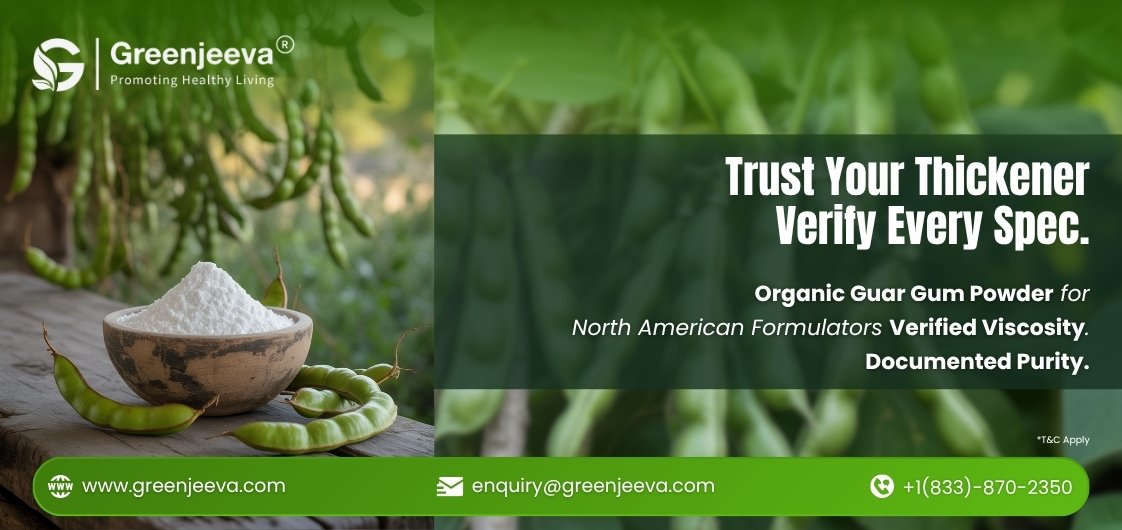
Every clean-label formulation starts with an ingredient that performs on paper and in production. For food, beverage, nutraceutical, and personal-care formulators across the U.S. and Canada, Organic Guar Gum Powder is that silent workhorse, delivering thickening, stabilization, and mouthfeel consistency.
For formulators wondering where to buy bulk guar gum powder in the USA, sourcing from a verified clean label thickener supplier in North America ensures consistent functionality and regulatory readiness. Leading food-grade organic guar gum Canada suppliers also cater to nutraceutical and beverage applications where texture and stability are critical.
Yet, in an industry where supplier claims vary, specifications and traceability are what separate dependable sources from the rest. Whether you’re a procurement lead at a beverage company in California or an R&D formulator in Toronto, here are the seven must-checks you should verify before approving or switching a bulk supplier.
1. Confirm Galactomannan Content the Core of Guar Gum Functionality
What is galactomannan in guar gum and why does it matter?
Galactomannans are the natural polysaccharides that give guar gum its thickening and stabilizing ability.
Higher galactomannan = stronger performance in less dosage.
For food-grade organic guar gum, look for not less than 70 % galactomannan (dry basis). Ask for the exact value on the supplier’s COA and ensure it’s verified using a recognized USP or ISO method. This determines how efficiently the powder hydrates and produces viscosity in your final blend.
Buyers focusing on beverage formulations should specifically seek highest galactomannan guar gum for beverage use, as it offers superior hydration and dispersion in low-pH systems.
2. Verify Viscosity Specifications and Testing Method
How do you test guar gum viscosity?
Viscosity indicates hydration behavior and thickening potential. It’s usually measured as a 1 % aqueous solution using a Brookfield viscometer at 25 °C.
In North America, most buyers expect values of ≥ 3,500 cPs (at 24 hours) for high-quality organic grades. Ask for detailed method parameters, spindle type, RPM, hydration time. If the supplier cannot replicate results in your lab, consistency becomes a risk.

For documentation readiness, request the guar gum viscosity test method download and ensure it aligns with your internal QA validation SOPs. This addition helps verify the guar gum viscosity specification against the supplier’s published COA.
3. Check Microbial and Heavy-Metal Compliance
U.S. FDA and CFIA regulations require strict microbial control for food and nutraceutical inputs. A supplier’s COA should show:
- E. coli: Negative
- Salmonella: Negative
- Total Plate Count: Within limits (<10⁴ CFU/g)
- Lead: ≤ 2 ppm
- Arsenic: ≤ 3 ppm
Ensure these tests are conducted by ISO 17025-accredited labs and that methods align with USP <2022> and <232>. Many North American buyers also request optional pesticide and mycotoxin screens for organic grades.
4. Validate Organic Certification & GMO-Free Status
Why choose organic guar gum over regular?
Organic certification ensures the gum is sourced from pesticide-free crops and processed without synthetic solvents or irradiation.
For U.S. buyers, look for USDA Organic or NOP-equivalent certification. Canadian buyers should verify compliance with the Canadian Organic Regime (COR). Ask for the certificate scan with valid dates and certifying body name (e.g., ECOCERT, Control Union). Confirm “Non-GMO” and “Allergen-Free” statements as these affect label claims and export eligibility.
If you’re importing, always confirm the supplier can import Organic Guar Gum into the USA under USDA NOP or COR equivalency.
5. Evaluate Traceability and Batch Consistency
Modern procurement demands traceable supply chains. Ask:
- Is each batch traceable back to a specific production lot and region of India?
- Are records digitally archived and auditable?
- Does the supplier offer COAs for previous batches to prove consistency?
Batch-to-batch variations in viscosity or galactomannan can disrupt formulations. Top batch consistency guar gum suppliers share rolling batch data and maintain retention samples for 24 months for QA retesting. Some even provide guar gum COA downloads directly from their documentation portals.

6. Inspect Packaging, Storage & Shelf-Life Specifications
For bulk shipments to the U.S. and Canada, preferred packaging includes:
- Multi-layer kraft bags with poly liners (25 kg net).
- Optional fiber drums for cosmetic applications.
- Palletized and shrink-wrapped for moisture protection.
Shelf life typically extends 24 months under cool, dry conditions (<25 °C, RH < 60 %). Buyers should confirm remaining shelf life on delivery (≥ 12 months preferred).
When comparing guar gum vs xanthan gum in bulk, remember that guar gum typically provides better viscosity at lower dosage, making it more cost-efficient for food-grade and beverage formulations.

7. Assess Supplier Support & Technical Documentation Access
A reliable supplier does more than ship powder. They provide transparency and speed. Check whether they offer:
- Instant access to COA and spec sheets.
- Responsive technical support (under 24 h reply).
- Application guidance for food, beverage, and cosmetic formulations.
- Audit readiness with complete document packs (QA statement, GMO, allergen, BSE/TSE free).
In North American markets, buyers prioritize partners who are digitally ready, able to share files, certificates, and compliance records instantly.

Regional Considerations for U.S. and Canadian Procurement Teams
- U.S. Import Readiness: Check for FDA Registration and Prior Notice Capability.
- Canadian Imports: Ensure the supplier complies with CFIA documentation for organic materials.
- Trade Simplification: Suppliers experienced with USMCA documentation can reduce customs delays.
- Warehouse Availability: Ask if the supplier has U.S. or Canadian stock for shorter lead times.
Conclusion: Quality You Can Measure
Bulk buyers today aren’t just buying powder, they’re buying proof. From galactomannan percentages to organic certificates and batch COAs, every spec you verify reduces risk and ensures product stability.
Whether you’re sourcing for bakery, beverage, or personal-care applications, partner with a clean label thickener supplier in North America who can provide high-purity grades, clear COAs, and sample support.
Looking for a reliable partner? Explore where to buy bulk organic guar gum powder in the USA from trusted exporters experienced in organic guar gum supply across North America. Choose a supplier who understands compliance, documentation, and performance , from galactomannan value to viscosity control.
**The Food and Drug Administration has not evaluated these statements. This product is not intended to diagnose, treat, cure, or prevent any disease.**