Beyond Price: Strategic Considerations for Sourcing Plant Proteins in 2026
Sourcing protein ingredients used to be straightforward—compare prices, check availability, and place the order.
That approach doesn’t hold up anymore.
In 2026, protein sourcing decisions sit at the intersection of supply stability, processing requirements, and operational efficiency. A small variation in mesh size or format can affect production flow. A minor delay in supply can disrupt entire batches. And price, while still important, is no longer the only lever that matters.
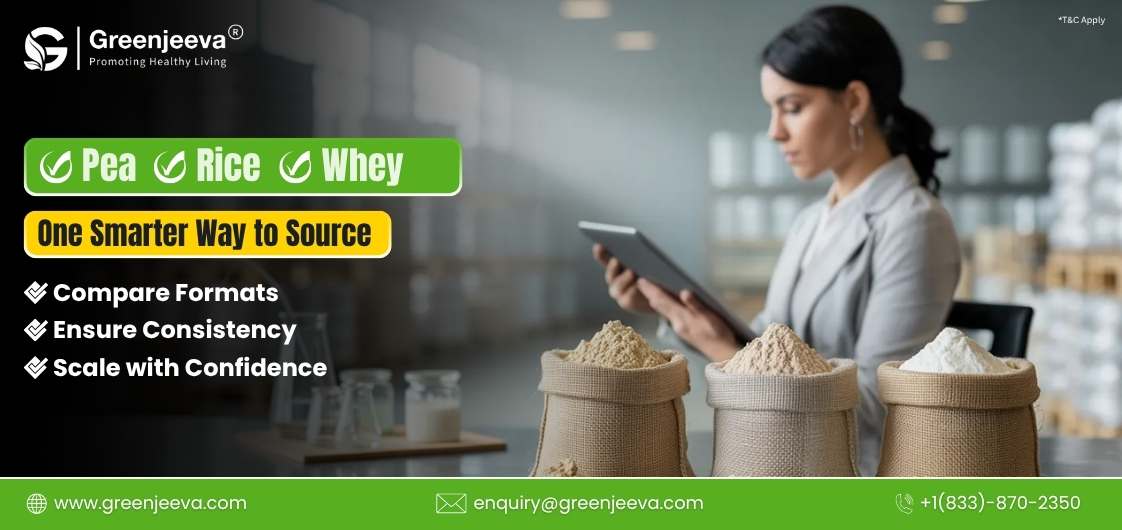
For procurement and supply chain teams, the focus has shifted from transactional buying to strategic sourcing—especially when working with high-demand formats like bulk pea protein powder, bulk rice protein powder, and bulk whey protein powder.
This is where the real decisions are being made.
Pea vs Rice vs Whey Protein: Not Just Alternatives, But Strategic Choices
At a glance, pea, rice, and whey proteins may appear interchangeable. In practice, they behave very differently—from sourcing to processing to supply reliability.
Pea protein has seen strong momentum in recent years, particularly in plant-based formulations. Many buyers prefer bulk pea protein powder for its relatively flexible sourcing ecosystem and increasing availability across regions. It’s also commonly available in instant formats, which can simplify handling at scale.
Rice protein, particularly organic brown rice protein powder, is often selected for its consistency and finer particle structure. Compared to other plant proteins, bulk rice protein powder—especially in fine mesh variants—can offer better uniformity in blending and processing environments where texture matters.
Whey, on the other hand, operates within a more established global supply chain. Bulk whey protein powder remains widely used across industries, but its sourcing dynamics are closely tied to dairy market fluctuations. This makes it more sensitive to external factors like feed costs, export trends, and seasonal production cycles.
So, the decision isn’t just about plants vs. dairy. It’s about how each protein aligns with your supply expectations, processing setup, and risk tolerance.
Supply Stability & Price Fluctuations in 2026
One of the biggest misconceptions in protein sourcing is that pricing is purely supplier-driven.
In reality, it’s shaped by a combination of upstream and global factors.
Pea and rice proteins are directly influenced by agricultural output. Weather conditions, crop yields, and regional farming patterns all play a role. This is why buyers sourcing through pea protein powder wholesale networks often see price shifts tied to harvest cycles or regional supply changes.
Rice protein follows a similar pattern, though organic variants can add another layer of variability due to certification requirements and limited sourcing regions. Working with a reliable organic brown rice protein powder supplier becomes less about cost negotiation and more about consistency and traceability.
Whey protein behaves differently. Since it is derived from dairy processing, its pricing is influenced by milk supply, global demand for dairy products, and export activity. Buyers relying on whey powder wholesale channels are often exposed to more frequent price fluctuations, especially in high-purity formats.
The takeaway here is simple: price is an outcome, not a starting point. Stable sourcing depends on how well you understand the supply chain behind each protein.

Functional Specifications That Impact Procurement Decisions
Beyond sourcing and pricing, functional specifications play a critical role in how proteins perform during manufacturing. This is often where procurement decisions directly impact production efficiency.
Instantization: Why It Matters in Bulk Supply
Instantization refers to how easily a powder disperses in liquid or integrates into a formulation. For large-scale operations, this isn’t a minor detail; it affects mixing time, flowability, and overall process efficiency.
Formats like pea protein powder 80% instant are designed for improved handling and dispersion, reducing operational friction during production. Similarly, 90% instantized whey powder is often preferred in applications where consistency and quick integration are important.
Choosing between instant and non-instant formats comes down to your processing environment and the level of efficiency you need on the production floor.
Mesh Size & Texture: The Overlooked Specification
Mesh size is one of the most overlooked factors in protein sourcing, yet it has a direct impact on texture, blending, and uniformity.
Fine mesh rice protein powder, for example, offers a smoother and more consistent particle size, which can improve how the ingredient behaves during mixing and formulation. This becomes especially relevant in applications where clumping or uneven distribution can create production challenges.
Organic brown rice protein powder 80%, 600 mesh, is a good example of how specification-level detail can influence usability. A finer mesh doesn’t just affect texture; it can also streamline processing and reduce variability between batches.
Protein Concentration & Format Consistency
Protein concentration—such as 80% vs 90%—is another key consideration, but not just from a specification standpoint.
Consistency across batches matters just as much.
Brown rice powder 80% protein is widely used across applications where a balance between concentration and processability is required. On the other hand, higher concentration formats like whey protein powder 80%, instantized may require tighter quality control to ensure uniformity across shipments.
For procurement teams, this translates into one key question:
Can your supplier deliver the same specification, consistently, at scale?
Ingredient-Level Sourcing Insights
Looking at individual ingredients helps bring these considerations into focus.
Organic brown rice protein powder continues to be a reliable option for buyers prioritizing consistency and fine particle size. Whether sourced as bulk rice protein powder or through specialized organic channels, its performance is often tied to mesh quality and supplier reliability.
Pea protein powder 80%, instant has become a preferred format for manufacturers looking for ease of handling and scalability. As demand grows, working with a dependable bulk pea protein powder supplier becomes essential to maintaining uninterrupted supply.
Whey protein powder 80%, instantized remains a high-demand ingredient with established supply chains. However, its sourcing requires close attention to market fluctuations, making it important to partner with an experienced whey protein powder bulk supplier who can provide both stability and transparency.
Each of these ingredients serves a different purpose, but the sourcing approach behind them is what ultimately determines operational success.
What Procurement Teams Should Evaluate
In today’s market, choosing the right protein isn’t just about the ingredient; it’s about the system behind it.
Procurement teams are increasingly prioritizing suppliers who can offer more than just product availability. Access to detailed documentation like COAs and specifications is no longer optional; it’s expected. The same goes for real-time inventory visibility, clear warehouse information, and consistent communication across orders.
Equally important is format consistency. Whether you’re sourcing bulk pea protein powder, organic brown rice protein powder, or whey powder wholesale, variations between batches can create downstream challenges that are far more costly than initial price differences.
Scalability is another factor that often gets overlooked. A supplier may meet your current requirements, but can they support your growth without compromising on quality or timelines?
These are the questions that define strong sourcing strategies in 2026.

Final Thoughts
Protein ingredients are no longer just commodities moving through a supply chain.
They are inputs that directly influence production efficiency, product consistency, and operational stability.
For procurement and supply chain teams, this means thinking beyond price—toward a more structured approach that considers supply reliability, functional specifications, and long-term scalability.
Because in today’s environment, the real advantage doesn’t come from sourcing cheaper.
It comes from sourcing smarter.