What Makes Beetroot Powder a Natural Colourant?
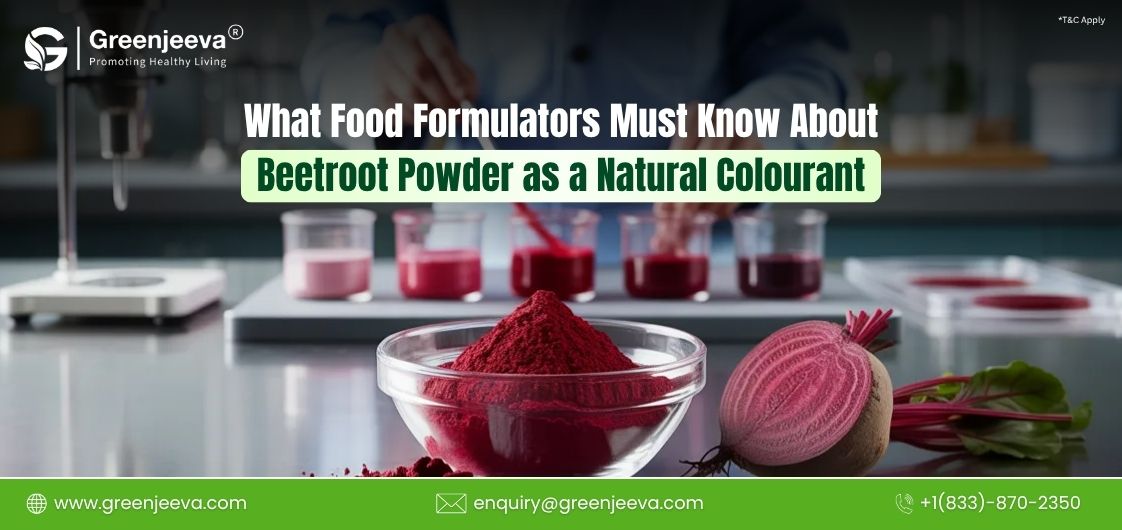
From a regulatory standpoint, beet‑derived color sits comfortably under “no artificial colors” claims in U.S. and North American markets, making it a practical fit for brands reformulating away from synthetic reds.
Beetroot Powder as a Natural Food Colourant in Food Manufacturing
The primary pigments in beetroot powder and beetroot juice powder are betalains, specifically:
- Betacyanins → red to purple tones
- Betaxanthins → yellow to orange tones
Together, they allow formulators to create a wide spectrum of shades—from light pink to deep burgundy.
Compared to anthocyanins (from berries):
- Betalains offer more predictable reds in neutral systems
- They are less prone to blue/purple shifts
- But they are more sensitive to heat and oxygen
This makes beetroot powder as a natural food colourant highly effective but also highly dependent on formulation and process conditions.
Where to Use Beetroot Powder: Applications in Beverages, Bakery, and Dairy
Not all systems treat natural color equally.
Bestfit applications
- Beverages & drink mixes → clean, vibrant reds
- Smoothies & functional blends → low heat exposure
- Plant‑based dairy → stable visual appeal
- Confectionery → controlled environments

More challenging applications
- High‑heat bakery
- Extruded snacks
- Long‑shelf‑life acidic beverages
The key is not just choosing organic beetroot powder but matching it to the right system and processing window.
Functional Factors Affecting Beetroot Powder Colour Stability
Heat Sensitivity
- Betalains degrade at high temperatures.
- Prolonged heat → color fading
- pH Stability
- Optimal: pH 4–7
- Outside range → color shifts and degradation
Oxygen & Light Exposure
- Leads to oxidation and browning
- Reduces shelf‑life visual quality
- Dispersion & Concentration
- Poor dispersion of raw beet powder leads to uneven coloring and spotting
What Affects Beetroot Powder Stability in Food Applications?
Heat, pH, oxygen exposure, and processing time are the primary factors that determine beetroot powder stability in beverages, bakery, and other food systems.
For R&D teams, this means:
Success is not just about ingredient selection, but about process design and packaging strategy.
Why Beetroot Colour Fails at Scale
- Vibrant in trials → fades under heat
- Stable initially → degrades over shelf life
- Consistent in lab → varies across batches
Beetroot colour doesn’t fail.
It responds to process conditions.
What Determines Beetroot Colour Stability
- Temperature exposure
- pH environment
- Oxygen contact
- Ingredient interactions
These four levers form a practical stability framework that U.S. food manufacturers can use to troubleshoot and optimize beet‑based color in beverages, bakery, and plant‑based dairy.
Beetroot Powder vs Synthetic Colours: Stability & Performance
Parameter | Beetroot Powder | Synthetic Colours |
Label Appeal | Clean‑label | Artificial |
Stability | Moderate | High |
Heat Resistance | Low–Moderate | High |
Consumer Preference | High | Declining |
Unlike synthetic dyes that remain stable across wide processing conditions, natural red food color from beetroot requires system‑specific optimization.
How to Use Beetroot Powder as a Natural Colourant
- Need clarity (beverages)? → Beetroot juice powder
- Need strong pigment at low dose? → Beet extract powder
- Need nutrition + color? → Organic beetroot powder
- Functional positioning? → Fermented beet powder
- This four‑way framework helps R&D teams quickly match the right beet‑based form to the right application.

Common Problems with Beetroot Powder in Food Manufacturing
Food manufacturers working with bulk beetroot powder USA often encounter:
- Color fading during processing
- Instability in acidic systems
- Batch‑to‑batch variation
- Off‑notes in flavor
These are not ingredient failures.
They are system‑level mismatches between ingredient and process.
Where Formulators Get It Wrong
- Treating beetroot powder as a direct dye replacement
- Ignoring processing conditions
- Validating only at lab scale
Stability issues often start with incomplete evaluation frameworks.
How Functional Properties Translate on a Spec Sheet
When sourcing beetroot powder bulk, performance is reflected through:
- Betalain content → color intensity
- Moisture → shelf stability
- Particle size → dispersion
- Solubility → application compatibility
These values indicate quality—but only testing within your formulation confirms performance.
Beetroot Powder Stability in Food Processing Systems
To improve stability:
- Add color at later stages of processing
- Reduce heat exposure (e.g., lower‑temperature baking, shorter pasteurization)
- Control pH within the stable window
- Use oxygen‑barrier packaging
Limit light exposure (opaque or UV‑blocking packaging)
Even small adjustments can significantly improve color retention in beet juice powder and organic beetroot powder systems.
What U.S. Food Manufacturers Should Evaluate Before Sourcing
When selecting a bulk beetroot powder supplier USA, focus on:
- Consistent pigment intensity
- Controlled processing (temperature, drying, handling)
- Batch‑to‑batch reliability
- Application‑level validation (e.g., data on beverages, bakery, or plant‑based dairy)
Because:
- Specs confirm compliance.
- Consistency confirms performance.
Where Sourcing Becomes a Formulation Decision
For brands working with bulk organic beetroot powder, sourcing directly impacts:
- Color consistency
- Stability
- Shelf‑life behavior
For R&D teams, supplier selection is not just about availability or pricing it’s about how consistently the ingredient performs under real production conditions and end‑use formats.

Final Insight: Natural Colour Requires Controlled Systems
Beetroot powder is one of the most effective natural red colorants available.
But it behaves differently from synthetic dyes.
It requires:
- Process control
- Formulation alignment
- Consistent sourcing
Because:
Achieving natural colour is easy.
Maintaining it at scale is where formulation expertise shows.