GLP-1 Companion Formulas: What Ingredient Buyers Need to Know About Magnesium Citrate Specification in 2026
A new product category has moved from emerging to mainstream in the span of eighteen months. GLP-1 companion supplements — formulas designed to sit alongside GLP-1 weight-management medications — are now one of the fastest-growing segments in the global supplement industry. For ingredient buyers and formulators building in this space, understanding which mineral grades are being specified, and why, is increasingly a commercial necessity rather than a technical detail.
The market context
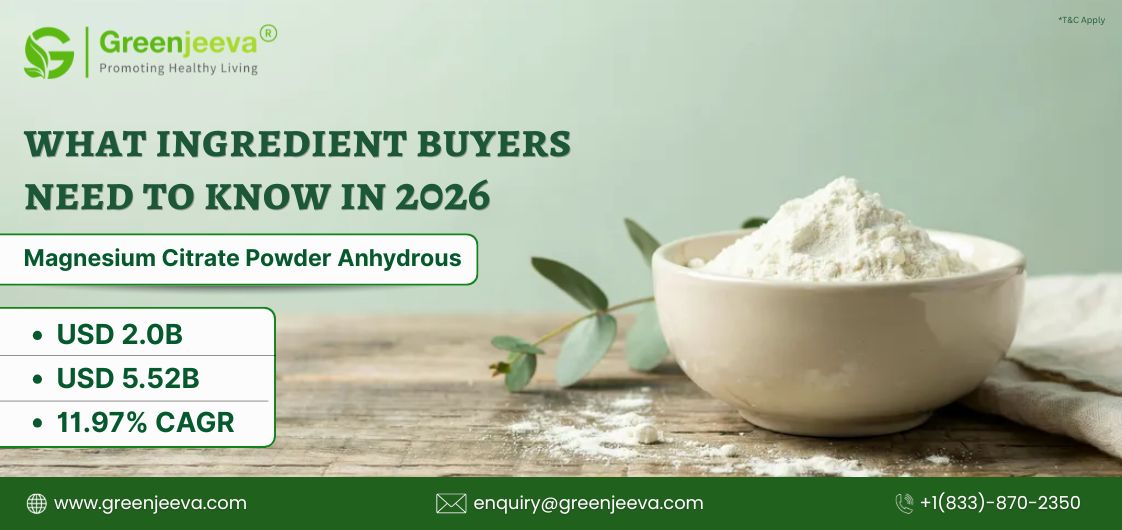
The GLP-1 companion supplement market was valued at approximately USD 2.0 billion in 2025 and is projected to reach USD 5.52 billion by 2034, growing at a CAGR of 11.97% from 2026 to 2034 (Straits Research, 2026). This is not a niche. It is one of the highest-growth sub-segments in the entire supplement industry, attracting investment from major players including Nestlé Health Science, Abbott, Herbalife, and Thorne, alongside a wave of new direct-to-consumer brands.
The category is structured around a clear formulation brief: users of GLP-1 medications consume roughly 20% fewer daily calories, which changes the nutritional composition of their daily intake. As a result, brands formulating in this space are building products that prioritise nutrient density in smaller-volume formats — particularly powdered stick packs, capsule multiples, and low-volume drink mixes. The format requirement has direct implications for ingredient specification.
Why ingredient buyers are specifying magnesium citrate anhydrous
Among the minerals being prioritised in GLP-1 companion formulas, magnesium is consistently listed alongside protein, fibre, B-complex vitamins, and electrolytes. Within the magnesium category, formulators are specifically moving toward the citrate anhydrous grade — and the reasoning is technical, not arbitrary.
Elemental magnesium concentration: The anhydrous form delivers approximately 16.2% elemental magnesium by weight, compared to around 12% for the nonahydrate. In a low-volume capsule or sachet format where dose weight is constrained, this concentration advantage allows formulators to include a meaningful amount of elemental magnesium without increasing capsule count or sachet fill weight. For multi-ingredient companion formulas that are already combining protein, vitamins, and minerals, this matters.
Solubility and format compatibility: Magnesium citrate anhydrous dissolves readily in water — typically 3 grams per 100 ml within three minutes under standard conditions — making it compatible with both dry-blend sachets and encapsulation at scale. It also demonstrates good flow properties and consistent particle size (typically ≥99% through a 60-mesh screen), which directly impacts capsule filling efficiency and powder blend uniformity.
Clean label positioning: GLP-1 companion products are predominantly positioned as pharmaceutical-grade or doctor-adjacent — premium products where ingredient transparency and documentation are part of the brand story. Magnesium citrate anhydrous is non-GMO, allergen-free, and free from synthetic additives by nature of its production process, which satisfies the clean-label requirements that premium positioning demands.
Low hygroscopicity in the anhydrous form: Unlike the nonahydrate grade, which can exhibit more hygroscopic behaviour in humid environments, the anhydrous form is inherently lower in bound water — reducing the risk of caking in powder blends and extending stability in sachet formats without requiring aggressive packaging interventions.

What procurement teams should verify on the COA
As the GLP-1 companion category scales and more brands enter formulation, supplier evaluation standards are tightening. Procurement teams sourcing magnesium citrate anhydrous for this category should expect and verify the following on any Certificate of Analysis before placing an order:
- Magnesium assay: Specification range 14.5–16.4% elemental Mg (USP/EP grade standard). Batch-specific assay values should be reported; in-range assay confirms you are working with the anhydrous rather than a partially hydrated grade.
- Loss on drying: ≤0.5% is the accepted standard for the anhydrous form. Values above this threshold indicate residual moisture and should prompt clarification on whether a hydrated grade has been supplied.
- Heavy metals by ICP-MS: Lead ≤1 ppm, Arsenic ≤3 ppm, Mercury ≤0.1 ppm, Cadmium ≤1 ppm. For a premium companion formula category where brand risk is high, verifying these against actual batch data — not just a product spec sheet — is a non-negotiable.
- pH: Typically 7.5–9.0 in solution. pH out of this range can affect taste in sachet and beverage formats and signals potential production process variation.
- Microbial limits: Total aerobic count, yeast and mould, absence of Salmonella and E. coli per USP standards.
- Particle size uniformity: ≥99% through 60 mesh for standard powder grades. Confirm mesh specification if your manufacturing process requires direct compression in tablet formats.

Sourcing considerations for a new SKU launch
GLP-1 companion supplement launches are frequently fast-moving — brands entering the market in 2026 are working on compressed timelines to capture early category growth. For ingredient buyers managing a new SKU launch, the minimum order quantity (typically 25 kg for magnesium citrate anhydrous in standard B2B supply), shelf life (24–36 months in sealed, low-humidity storage), and documentation turnaround should be confirmed during supplier qualification, not after the purchase order is placed.
Multi-origin supply capability is increasingly relevant. Following US tariff actions in 2025 that raised ingredient costs for China-sourced minerals, procurement teams are actively seeking suppliers with verified India, Germany, or Japan-origin alternatives available within the same quality specification. Green Jeeva's Magnesium Citrate Powder Anhydrous is sourced from India, Germany, China, and Japan — providing origin flexibility that directly addresses dual-sourcing requirements without requiring a supplier change.
The formulation opportunity
The GLP-1 companion supplement category is growing at nearly 12% annually and is projected to more than double in value by 2034. The brands entering now are building product lines that will require consistent, specification-driven mineral supply for years. For ingredient buyers, aligning early with a reliable, well-documented source of magnesium citrate anhydrous — verified on both COA and origin flexibility — is a straightforward supply chain decision with compounding value as product volumes scale.
For full product specifications, batch documentation, and wholesale pricing on Magnesium Citrate Powder Anhydrous, visit greenjeeva.com or contact our team directly.
Note: Information contained herein is offered in good faith for market intelligence and formulation guidance purposes. Green Jeeva LLC assumes no liability or risk involved in the use of its products. These statements have not been evaluated by the Food and Drug Administration.