How to Source Bulk Organic Slippery Elm Bark Powder: A B2B Buyer's Guide to Certification, Consistency, and Supplier Qualification
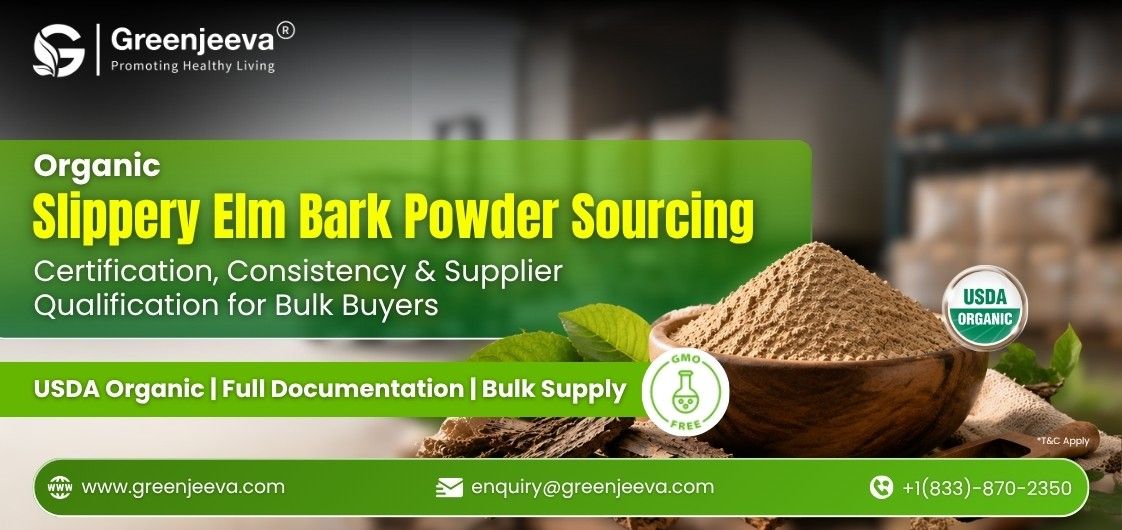
Sourcing botanical powders at commercial scale exposes procurement teams to a specific class of risk that general ingredient categories don't carry. Harvest-dependent variability, certification gaps don't surface until an audit, and supplier documentation passes a quick review but fails regulatory scrutiny. Organic Slippery Elm Bark Powder sits squarely in this category.
This guide is written for procurement managers, sourcing heads, and product developers who need to evaluate Slippery Elm Bark Powder suppliers at the wholesale and bulk level — not for a general audience. It covers what certified organic documentation must actually prove, how to assess yield consistency across production cycles, and the criteria that distinguish a reliable manufacturer from one that will create problems mid-formulation.
Why Slippery Elm Bark Powder Demands Stricter Sourcing Standards
Most bulk botanical powders are plant-derived, but not all carry the same sourcing complexity. Slippery Elm (Ulmus rubra) bark is harvested from wild-stand trees, primarily in Appalachian and Great Lakes regions of North America. That means supply is tied to seasonal harvest windows, regional availability, and the variable quality of harvester relationships — not a controlled agricultural supply chain.
For manufacturers in the nutraceutical, food, and cosmetic sectors, this translates directly into risk. The mucilaginous polysaccharides that define Slippery Elm's functional profile vary by harvest season, bark maturity, and post-harvest handling. A supplier who sources opportunistically — buying from multiple brokers across seasons — will produce materially inconsistent powder batches, even under the same Organic Slippery Elm Bark Powder Wholesale SKU.
Powder vs. extract: what the specification actually means
Slippery Elm Bark Powder is a mechanical reduction of the bark — not a concentrated or standardized extract. That distinction matters for formulation. Powder retains the full-spectrum fiber and mucilage matrix; an extract isolates specific constituents. Buyers sourcing for nutraceutical applications should confirm they're specifying the correct form, because the supplier's published spec sheet may list both under similar product names.
Decoding the COA: What Certified Organic Documentation Must Actually Prove
A Certificate of Analysis is the most commonly requested document in botanical ingredient sourcing — and the most frequently misread. For USDA Organic Slippery Elm Bark Powder, a COA is not just a compliance checkbox. It is diagnostic data. Here is what it must contain to be actionable.
Identity verification
The COA should confirm botanical identity using organoleptic assessment and a validated analytical method — HPTLC (High-Performance Thin-Layer Chromatography) is the preferred standard. The accepted Latin binomials are Ulmus rubra and Ulmus fulva. A COA that lists only a common name or describes identity testing as 'visual inspection' does not meet the bar for B2B nutraceutical supply.
Microbial, heavy metals, moisture, and particle size
For food and supplement-grade Organic Slippery Elm Bark Powder in Bulk, the COA microbial panel must cover Total Plate Count, yeast and mold, E. coli, and Salmonella — at minimum. Heavy metals testing for lead, arsenic, cadmium, and mercury is mandatory for any material entering a finished product intended for consumption. USDA Organic certification does not confer heavy metal compliance; soil and water contamination at the harvest site are independent variables.
Moisture content is particularly critical for bark powders. Slippery Elm is hygroscopic — moisture above 10–12% creates compaction during transit and microbial risk in storage. Loss on Drying (LOD) must be explicitly reported. Particle size distribution — not just a nominal mesh designation — confirms blendability and dissolution behavior for your specific application.
USDA Organic vs. Non-GMO: scope differences buyers often miss
These are separate certification systems with different scopes. USDA Organic Slippery Elm Bark Powder Distributor certification confirms that the material was produced without synthetic pesticides and under an approved organic system plan. Non-GMO Slippery Elm Bark Powder Wholesale certification — typically Project Verified or equivalent — confirms genetic integrity. A material can hold one without the other. For clean-label product development, verify that your supplier holds both, and that each certificate covers the processing facility, not just the raw material origin.

Yield Consistency: The Variable That Breaks Formulations Mid-Cycle
Procurement managers who evaluate a supplier on a single COA are working with incomplete information. One batch can pass every test and still not reflect what you will receive on the third or fifth order. Yield consistency — specifically mucilage content, particle profile, and moisture stability across production cycles — is the metric that separates a reliable Certified Organic Slippery Elm Supplier from one that will create downstream reformulation costs.
What three non-consecutive COAs actually reveal
Request COA data from at least three non-consecutive production batches during supplier qualification. Compare moisture content, particle distribution, and microbial loads across those batches. Meaningful drift — especially in moisture or particle distribution without accompanying production notes — points to inconsistent sourcing geography, mixed-origin bark, or inadequate process controls at the milling stage. A Slippery Elm Bark Powder Manufacturer with robust internal QC will have this data available and will share it without friction.
Harvest origin and traceability standards
Spring-harvested bark from established wild stands carries higher mucilage content than opportunistically sourced material. Ask your supplier to confirm harvest origin by region and whether they source from registered organic-certified harvesters or certified agricultural operations. Suppliers of Private Label Slippery Elm Bark Powder who cannot trace material to the harvest unit — not just the processing facility — are operating below the traceability standard that regulated product development now requires.
Supplier Evaluation Criteria for Private Label and Wholesale Orders
When qualifying a Organic Slippery Elm Bark Powder Wholesale supplier for ongoing commercial supply, the documentation checklist is the starting point — not the endpoint. Operational factors determine whether the supplier can perform reliably at scale.
In-house milling vs. toll processing
Suppliers who control their own milling operations can respond faster to custom particle size specifications and maintain tighter contamination controls than those who outsource grinding to toll processors. For buyers placing bulk orders with specific mesh requirements, in-house milling is a meaningful operational differentiator. Toll-processed material introduces lead time variability and third-party contamination risk that compound over order cycles.
Qualification checklist for procurement teams
Before placing an initial bulk order with any Slippery Elm Bark Powder Manufacturer or distributor, confirm the following:
• Current USDA Organic certificate covering raw material sourcing and the processing/milling facility
• Full COA: identity (HPTLC or equivalent), microbials (TPC, yeast/mold, E. coli, Salmonella), heavy metals (Pb, As, Cd, Hg), LOD/moisture, and particle size distribution
• Non-GMO Slippery Elm Bark Powder Wholesale verification — Project Verified or equivalent supplier attestation
• COA data from at least 3 non-consecutive production batches
• Confirmed harvest origin and traceability to certified organic harvesters or farms
• In-house milling capability or documented toll processor qualification protocol
• Allergen and cross-contamination controls for shared processing lines
• Lead time commitment for standard bulk orders and rush accommodation policy
• Private Label Slippery Elm Bark Powder capability including custom blending, if applicable to your pipeline

Making the Sourcing Decision: What Matters Most
Buyers who evaluate Certified Organic Slippery Elm Supplier relationships on price per kilogram alone systematically underestimate the downstream cost of inconsistent supply. Reformulation cycles, compliance remediation, and supply disruptions routinely cost more than the difference between a well-qualified supplier and a cheaper alternative.
The evaluation framework outlined here — COA depth, yield consistency data, traceability, and operational qualification — is not due diligence overhead. It is the minimum information set required to make a sourcing decision that holds up across multiple order cycles and regulatory review.
Green Jeeva LLC supplies USDA Organic and Non-GMO certified Slippery Elm Bark Powder in bulk and wholesale quantities to manufacturers across nutraceutical, food, and personal care sectors. Free samples, full documentation access, and same-day dispatch from US warehouse locations are available. Contact the team to begin qualification.
**The Food and Drug Administration has not evaluated these statements. This product is not intended to diagnose, treat, cure, or prevent any disease.**